
On this page
Maca vs Ashwagandha: Which One Should You Take?
Quick answer: take ashwagandha if your problem is stress, a racing mind at night, or poor sleep. Take maca if your problem is low libido, low drive, or menopause-related mood dips. They target different things, so neither is “stronger” than the other.
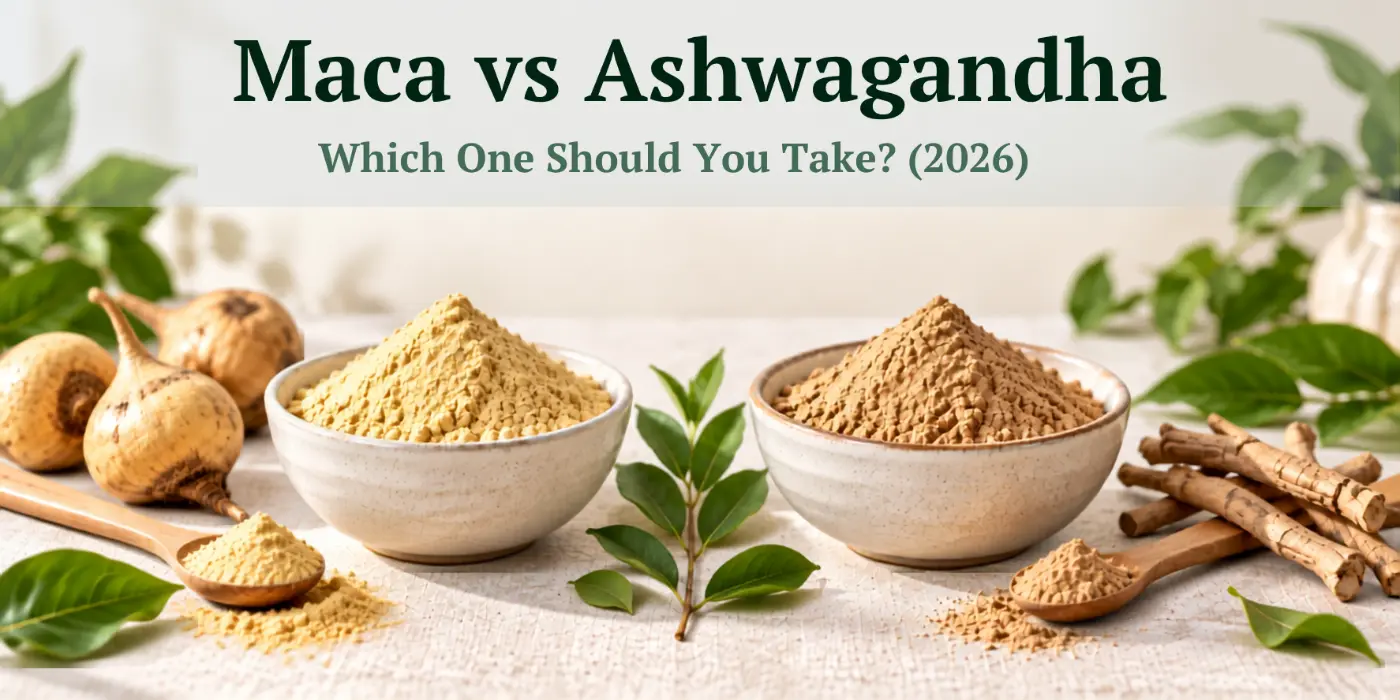
These two get compared constantly, usually as if you have to pick a winner. You do not. Maca and ashwagandha are both called adaptogens, but the research behind them points in completely different directions, and the honest answer to “which is better” is “better at what?”
This page lays out what each one actually has evidence for, the doses used in the studies, how long each takes, and who should stay away from them.
Maca vs ashwagandha at a glance
| Ashwagandha | Maca | |
|---|---|---|
| What it is | Root of an evergreen shrub used in Ayurveda | Root vegetable grown in the Peruvian Andes |
| Best evidence for | Stress and cortisol, sleep quality | Libido and sexual function, menopause mood |
| Strength of that evidence | Moderate for stress, weak to moderate for sleep | Limited, small trials, effects modest |
| Typical study dose | 300 to 600 mg extract daily | 1.5 to 3 g powder daily |
| Time to notice | 6 to 8 weeks | About 12 weeks |
| Does it move hormones | Can raise testosterone and affect thyroid values | Does not appear to change oestrogen or testosterone |
| Main caution | Rare liver injury, thyroid and autoimmune conditions | Little long-term safety data, lead contamination in one case |
They are not really competing
The word adaptogen groups them together, and that is where most of the confusion starts. An adaptogen is a loose marketing category, not a mechanism. Two plants can both sit in it and do nothing alike.
Ashwagandha shows up in the literature mostly around stress markers and sleep. Maca shows up mostly around sexual function and menopausal symptoms. There is very little overlap in what has actually been measured, which is why the “which is better” question usually has no useful answer until you say what you are trying to fix.
What ashwagandha actually does
The strongest signal is stress. A 2021 systematic review covering seven studies and 491 people found significant reductions in stress and anxiety scores, and an international taskforce provisionally suggests 300 to 600 mg a day for generalised anxiety while noting more research is needed. NIH ODS summarises the trial range as 225 to 1,250 mg of extract daily, with 500 to 600 mg performing better than lower doses.
Sleep is weaker. A review of five studies in 372 people found a small but real effect, clearer at 600 mg a day, after eight weeks or more, and clearer in people who already had insomnia than in people who slept fine.
Beyond that it thins out fast. NCCIH lists the evidence as insufficient for cognition, diabetes, asthma and athletic performance. Two to four months of use may raise testosterone and improve sperm measures in men, but that finding needs more work.
What maca actually does
Maca has a narrower and thinner evidence base, and it is worth saying so plainly. Examine describes limited research suggesting a modest increase in libido and a small improvement in sexual function, plus possible help with menopause symptoms, particularly mood, anxiety and low mood.
The interesting part is the mechanism. A trial in postmenopausal women found the psychological and sexual benefits were not explained by any change in oestrogen or androgen levels. Whatever maca is doing, it is not acting as a hormone, which is unusual for something sold in the hormone aisle.
Doses in studies run 1.5 to 3 g a day, most commonly 3 g, taken with food, over roughly 12 weeks.
How to choose in one minute
- Stressed, wired, poor sleep — ashwagandha. This is the one area with moderate evidence behind it.
- Low libido or low drive — maca. Modest effects, but this is where its trials are.
- Perimenopause or menopause mood dips — maca, and it does not act on hormones, which some people prefer.
- Thyroid condition, autoimmune condition, pregnant or breastfeeding — neither without a doctor, and ashwagandha in particular is off the table.
- General energy and nutrition — honestly, neither. That is a food, sleep and iron question first. Our energy superfoods guide covers that side.
Can you take maca and ashwagandha together?
There is no known interaction between the two, and because they act on different things, stacking them is common. But there is no trial testing the combination, so you are past the evidence the moment you do it.
If you do, start one at a time, four to six weeks apart. Otherwise, when something changes, you will not know which one did it, and if you react badly you will not know which to stop.
How long each one takes to work
Neither works in a week, and anything promising that is selling something.
Ashwagandha: stress trials generally run 6 to 12 weeks, and the sleep effect was clearer at eight weeks or more. Give it two months before deciding.
Maca: most studies ran 12 weeks. Three months is the fair trial period.
Both were studied as a daily habit, not something taken when you feel like it. Pairing it with an existing routine helps, which is one reason a fixed morning routine makes supplements easier to stick with.
Who should not take these
Ashwagandha, avoid or ask a doctor first if you:
- Are pregnant or breastfeeding
- Have a thyroid condition, or take thyroid medication, as it can raise T3 and T4 and lower TSH
- Have an autoimmune condition or take immunosuppressants
- Have liver disease. Case reports describe acute liver injury, with jaundice, itching, nausea and lethargy, at 450 to 1,350 mg daily over one to four months. People recovered after stopping
- Have hormone-sensitive prostate cancer
- Take sedatives, blood pressure or diabetes medication
- Have surgery coming up
Long-term safety beyond about three months is simply not known.
Maca, avoid or ask first if you are pregnant or breastfeeding, since safety there has not been established. One case report found elevated lead levels traced to a maca product, so third-party tested brands matter. Up to 3 g a day for no longer than about four months is the range that has been looked at.
None of this is medical advice, and neither is a substitute for treatment. If you take prescription medication, check with your doctor or pharmacist before adding either.
What to look for on the label
Most of the disappointment with either one comes down to buying the wrong form.
Ashwagandha: the trials used standardised root extract, not plain ground root. If a label says 1,000 mg but does not say extract or give a withanolide percentage, you are probably taking a much weaker dose than any study used. Named extracts such as KSM-66 and Sensoril are the ones most trials are built on. Aim for the studied range of 300 to 600 mg of extract, not the biggest number on the shelf.
Maca: gelatinised maca has the starch broken down and is easier on the stomach than raw powder, which is why some people find raw maca bloating. Colour matters less than the internet suggests. Because of the lead case report, third-party testing is the thing actually worth paying for here.
What the marketing gets wrong
- “Balances your hormones.” Maca measurably did not change oestrogen or testosterone in the trial that looked. Ashwagandha can move thyroid values and testosterone, which is a reason for caution, not a selling point.
- “Natural, so it is safe.” Ashwagandha has case reports of acute liver injury. Natural and safe are not the same claim.
- “Feel it in days.” The studies ran 6 to 12 weeks. Anything faster is expectation, not the supplement.
- “Adaptogen blend.” Blends usually split one studied dose across five ingredients, so none of them reaches the amount that was tested.
Frequently asked questions
Which is better, ashwagandha or maca?
Neither, in the abstract. Ashwagandha has the better evidence base overall, but only for stress and sleep. If your problem is libido, ashwagandha has almost nothing to offer and maca does. The better one is the one aimed at your actual problem.
Is maca better than ashwagandha for energy?
Both get sold for energy and neither has strong evidence for it. Maca has some mood and fatigue findings, mostly in postmenopausal women. Ashwagandha may help indirectly by improving sleep and lowering stress. If tiredness is your main complaint, rule out sleep debt, low iron and thyroid problems before buying either.
Can I take maca and ashwagandha at the same time?
No known interaction, and people do. Start them separately, several weeks apart, so you can tell what is working.
Do they work if you stop?
The effects in the trials were measured during use. Nothing suggests they persist once you stop, so treat either as ongoing rather than a course you finish.
The bottom line
Ashwagandha for stress and sleep, maca for libido and menopause mood. Ashwagandha has more research behind it, but it also carries the real cautions, particularly around the thyroid and the liver. Maca is gentler and thinner on evidence.
If you want the wider comparison including spirulina, we cover all three in ashwagandha vs spirulina vs maca.
Wondering how spirulina fits in? See spirulina vs ashwagandha.

Ahetesam Sabugar
Ahetesam Sabugar is the founder of Vigrovia. He researches and writes guides on skincare, supplements, fitness recovery and home-gym gear. He isn't a doctor, so every article is built from published studies, ingredient labels and trusted sources like the NIH and Cleveland Clinic, and is updated when new research comes out.
More articles by Ahetesam →