
On this page
Spirulina vs Ashwagandha: Which One Do You Actually Need?
Quick answer: take spirulina if you want extra protein, iron and antioxidants, or you are pushing your cholesterol and blood pressure in the right direction. Take ashwagandha if your problem is stress, a busy mind at night, or poor sleep. Most people who ask this question actually want one or the other, not a winner between them.
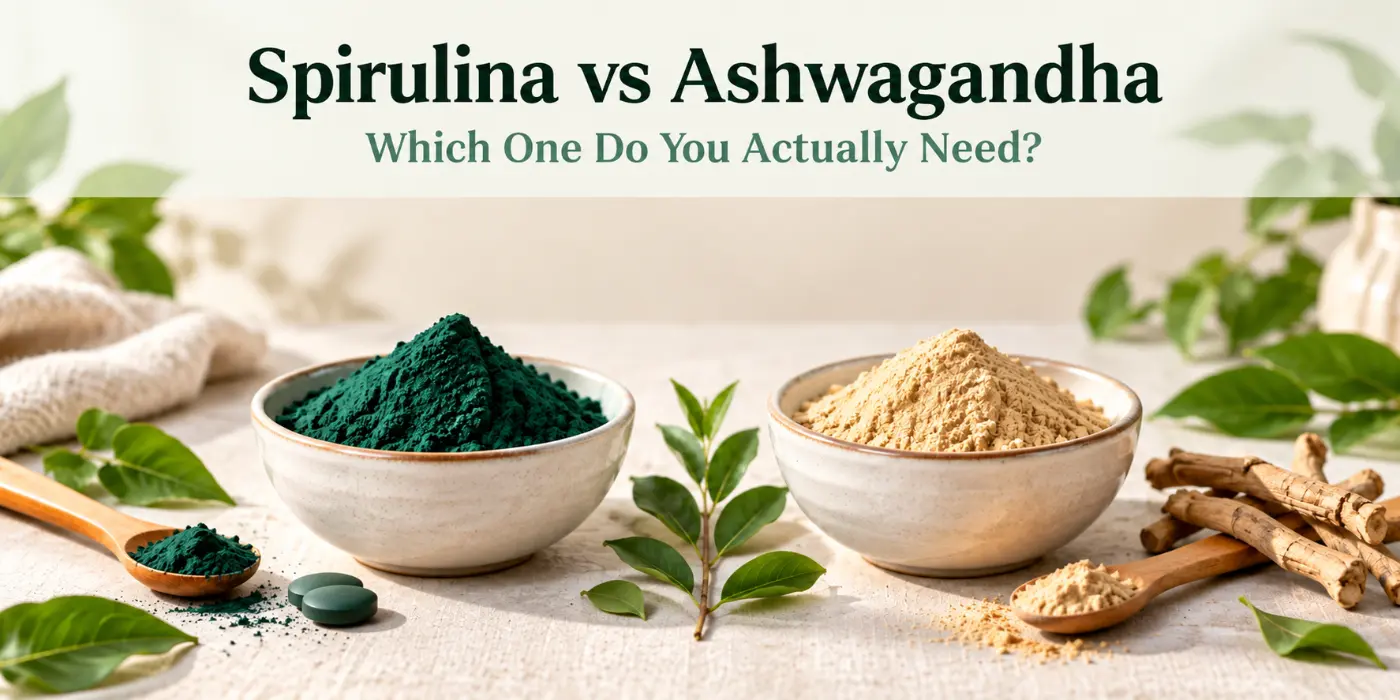
People line these two up as if they are rivals. They are not even in the same category. Spirulina is a food, an algae you eat for its protein and nutrients. Ashwagandha is a herb you take for stress and sleep. Choosing between them is like choosing between spinach and a sleeping aid, so the real question is which problem you are trying to solve.
Spirulina vs ashwagandha at a glance
| Spirulina | Ashwagandha | |
|---|---|---|
| What it is | Blue-green algae, eaten as a food and supplement | Root of a shrub used in Ayurveda |
| Main reason to take it | Nutrition: protein, iron, antioxidants | Stress, cortisol and sleep |
| Best evidence for | Lower triglycerides and blood pressure, allergic rhinitis | Lower stress and cortisol, better sleep |
| Typical study dose | 1 to 8 g daily | 300 to 600 mg extract daily |
| Time to notice | Weeks for blood markers; nutrition is immediate | 6 to 8 weeks |
| Main caution | Contamination in cheap brands, autoimmune conditions, PKU | Rare liver injury, thyroid and autoimmune conditions |
They solve completely different problems
This is the whole point, so it is worth being blunt. Spirulina is roughly 60 to 70 percent protein by weight and carries iron, B vitamins and the antioxidant phycocyanin. It behaves like a nutrient-dense food, and its measured effects are on things like cholesterol, triglycerides and blood pressure.
Ashwagandha carries almost no nutrition. It is taken for what it does to stress and sleep, and that is where its research sits. Neither one does the other one’s job. If you are tired because you are run down, that is closer to a spirulina and iron question. If you are tired because you are wired and not sleeping, that is closer to ashwagandha.
What spirulina actually does
The strongest signals are metabolic. Reviews summarised by Examine show a 10 to 15 percent drop in triglycerides in people with metabolic syndrome at 1 to 8 g a day, and a blood pressure reduction of roughly 11/6 mmHg in people who were not already hypertensive. Effects on total and LDL cholesterol are smaller and vary by who is taking it.
One area stands out: allergic rhinitis. A study found spirulina outperformed an antihistamine for nasal congestion, though it is a single study and needs replication.
On nutrition it is genuinely useful. A tablespoon (about 7 g) gives roughly 4 g of protein and 11 percent of the daily iron target. One caveat worth knowing: the B12 in spirulina is a form your body largely cannot use, so it is not a real B12 source despite the marketing.
What ashwagandha actually does
Ashwagandha has moderate evidence for stress. A 2021 systematic review of seven studies in 491 people found significant reductions in stress and anxiety, and the NIH ODS notes trials mostly used 300 to 600 mg of extract a day, with 500 to 600 mg working better than lower doses.
Sleep is weaker but real. A review of five studies in 372 people found a small but significant effect, clearer at 600 mg a day and after eight weeks, and clearer in people who already had insomnia.
Beyond stress and sleep the evidence thins out. NCCIH rates it insufficient for cognition, diabetes and athletic performance.
How to choose in one minute
- You want more protein, iron or antioxidants in your diet — spirulina. This is a food, and that is its job.
- You are working on cholesterol, triglycerides or blood pressure — spirulina, alongside your doctor, not instead of them.
- You are stressed, wired, or sleeping badly — ashwagandha. This is its one area of moderate evidence.
- Seasonal allergies and a blocked nose — spirulina has one promising study here.
- You have an autoimmune condition — be careful with both, and ask a doctor. Spirulina can stimulate the immune system and ashwagandha is also flagged for autoimmune conditions.
Can you take spirulina and ashwagandha together?
Yes, and it is a sensible pairing because they do not overlap. Spirulina covers nutrition, ashwagandha covers stress, and there is no known interaction between them.
The usual advice still holds: start one at a time, a few weeks apart, so that if something changes, good or bad, you know which one caused it. Spirulina is best taken with food; ashwagandha is often taken in the evening because of the sleep angle.
How long each one takes
Spirulina: the nutrition is immediate, since it is food. The blood-marker effects on triglycerides and blood pressure showed up over weeks of daily use in the trials, typically taking 1 to 8 g a day.
Ashwagandha: the stress trials ran 6 to 12 weeks and the sleep effect was clearer at eight weeks or more. Give it two months before deciding.
Both were studied as a daily habit. Pairing either with a fixed routine helps you stick with it, which is one reason a steady morning routine makes supplements easier to keep up.
Who should not take these
Spirulina, avoid or ask a doctor first if you:
- Have phenylketonuria (PKU) — spirulina contains phenylalanine, which people with PKU must avoid
- Have an autoimmune condition such as lupus, MS or rheumatoid arthritis — spirulina can stimulate the immune system
- Take blood thinners or have a bleeding disorder — it may slow clotting
- Are pregnant or breastfeeding — safety is not established
Buy carefully. Cheap or wild-harvested spirulina has been found contaminated with microcystins, which are toxic to the liver, and sometimes heavy metals. Choose brands third-party tested by USP, NSF or ConsumerLab.
Ashwagandha, avoid or ask first if you:
- Are pregnant or breastfeeding
- Have a thyroid condition or take thyroid medication
- Have an autoimmune condition or take immunosuppressants
- Have liver disease – case reports describe acute liver injury at 450 to 1,350 mg daily over one to four months, with recovery after stopping
- Take sedatives, blood pressure or diabetes medication, or have surgery coming up
None of this is medical advice. If you take prescription medication, check with your doctor or pharmacist before adding either.
What the marketing gets wrong
- “Spirulina is a superfood that does everything.” It is nutritious and has some real metabolic effects, but it is not a treatment. It will not fix stress or sleep.
- “Ashwagandha is a natural multivitamin.” It has almost no nutritional value. It is a stress herb, nothing more.
- “Natural, so safe.” Ashwagandha has liver-injury case reports; spirulina can be contaminated if poorly sourced. Natural is not the same as safe.
- “Feel it in days.” Ashwagandha needs weeks, and spirulina’s blood effects take weeks too.
Frequently asked questions
Which is better, spirulina or ashwagandha?
Neither, in the abstract. They do different jobs. Spirulina is better for nutrition and metabolic markers; ashwagandha is better for stress and sleep. The better one is whichever matches your goal.
Can I take spirulina and ashwagandha together?
Yes. They do not overlap and have no known interaction. Start them separately, a few weeks apart, so you can tell what each is doing.
Is spirulina or ashwagandha better for energy?
It depends on why you are tired. If you are run down or low on iron, spirulina is the better fit as a nutrient-dense food. If you are wired and not sleeping, ashwagandha may help by improving sleep and lowering stress. Rule out sleep debt and low iron before relying on either.
Does spirulina help with stress like ashwagandha?
No. Spirulina has no meaningful evidence for stress or anxiety. That is ashwagandha’s area, not spirulina’s.
The bottom line
Spirulina for nutrition, cholesterol and blood pressure. Ashwagandha for stress and sleep. They are not competitors, and for many people the honest answer is one, the other, or both for different reasons.
If you want the third option in this comparison, we cover maca as well in ashwagandha vs spirulina vs maca, and the direct maca vs ashwagandha comparison too.

Ahetesam Sabugar
Ahetesam Sabugar is the founder of Vigrovia. He researches and writes guides on skincare, supplements, fitness recovery and home-gym gear. He isn't a doctor, so every article is built from published studies, ingredient labels and trusted sources like the NIH and Cleveland Clinic, and is updated when new research comes out.
More articles by Ahetesam →