On this page
Too Overwhelmed to Clean? Try This Simple Guide
Quick answer: When you’re too overwhelmed to clean, stop aiming for a spotless home and work in short micro-bursts: set a timer for a few minutes and tackle one small zone. Feeling stuck isn’t a character flaw — it’s a mismatch between your energy and your system.
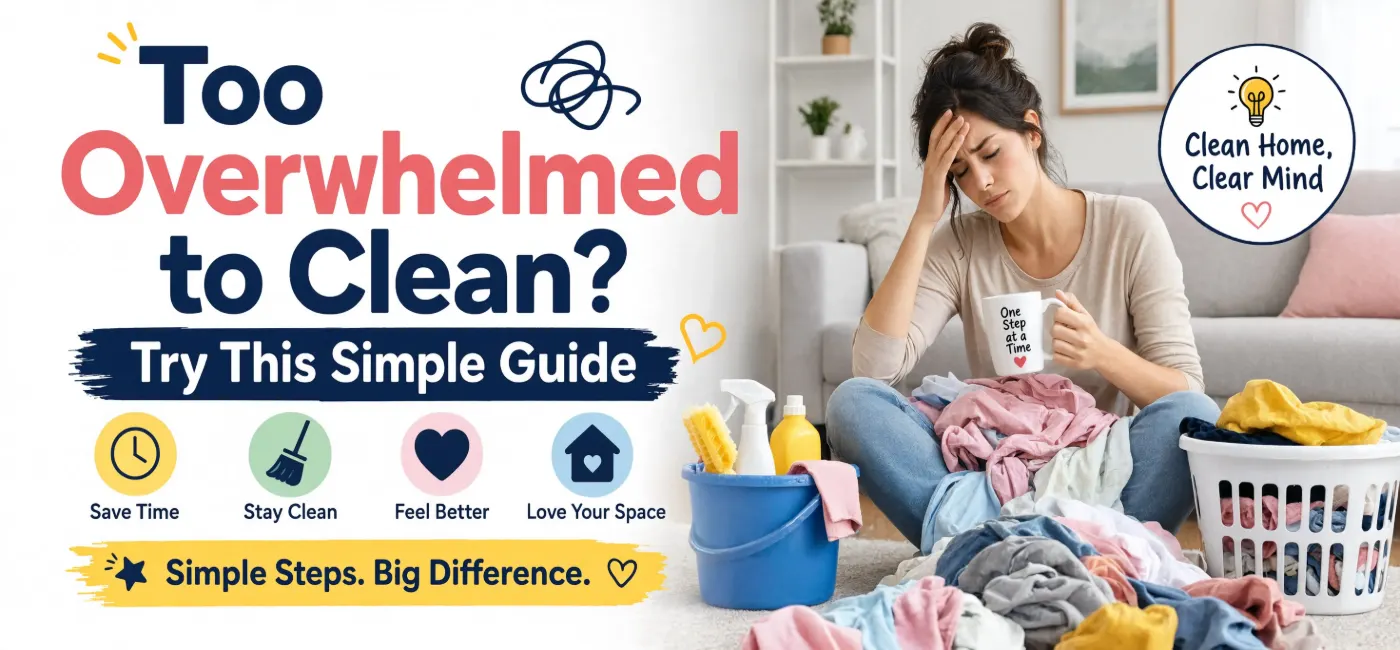
We have all been there. You stand in the doorway of a room, staring at a mountain of unwashed laundry, cluttered surfaces, and dirty dishes, and you feel an immediate, crushing weight in your chest. The traditional advice screams at you to “just push through it” or “never set it down, always put it away.”
But when you are dealing with chronic stress, burnout, depression, or neurodivergence like ADHD, that textbook advice doesn’t just fail – it paralyzes.
The truth is, the overwhelming feeling you experience isn’t a reflection of your character or discipline. It is a structural mismatch between your current energy levels and the unrealistic systems you are trying to force yourself into.
This guide is here to offer a different path. No judgment, no impossible standards. Just a gentle, psychology-backed blueprint to help you restore functionality to your home when your energy is at an absolute zero.
1. The Psychological Trap: Why Mess Feels Like a Moral Failing
Society has spent generations tying the cleanliness of a home to the moral worth of the person living in it. When things get out of hand, an insidious internal script often takes over: “If my house is a mess, I am a failure.”
Licensed family counselors and mental health advocates specializing in “struggle care” point out that this shame cycle is the single biggest barrier to getting things done. Shame is an emotional drain. It consumes the exact cognitive energy you need to initiate a task.
Shift from "Pinterest Perfect" to Functional Living
Your home is not a museum, and it is not a demanding boss you must appease. It is a passive space meant to serve you. When you decouple your self-worth from the state of your kitchen counters, you transform cleaning from a punishment into an act of self-care.
The Golden Rule of Shame-Free Cleaning:
A room does not need to be perfectly clean to be functional. It just needs to be safe, navigable, and supportive of your daily needs.
Defeating Decision Fatigue and Executive Dysfunction
Often, the paralysis you feel isn’t an aversion to the physical labor of tidying up—it is executive dysfunction. When every single object feels like an unresolved question (“Where does this go? Do I need to file this invoice or shred it? When was the last time I used this?”), your brain hits a cognitive wall.
To break this paralysis, you have to eliminate choices. You don’t need to decide the lifelong fate of every item in your house today. You just need a predictable, low-friction entry point.
2. The Core Framework: Micro-Burst Cleaning Techniques
When deep-cleaning a whole house feels like an impossible marathon, you need to switch to interval training. By breaking down your chores into tiny, time-capped sprints, you bypass the brain’s panic response.
The 20/10 Method
Popularized by home-care experts, the 20/10 cleaning method helps train your brain to view maintenance as a temporary, manageable burst rather than an endless journey.
Set Timer: 20 Mins ──► Focus entirely on one zone
Take Break: 10 Mins ──► Step away completely (No guilt!)
If 20 minutes feels too daunting right now, scale it down. A 5-minute tidy followed by a 20-minute break is still a massive victory. The goal is to build momentum, not to exhaust yourself.
High-Impact Starting Anchors
If you don’t know where to start, pick one of these four strategic areas. Tending to these spots gives an immediate visual payoff, instantly reducing your mental load:
The Walking Paths: Clear items strictly off the floor where you walk. A clear floor immediately cuts down the visual noise of a room.
The Kitchen Sink Reset: Don’t worry about the whole kitchen. Just wash the dishes inside the sink basin. Reclaiming that small workspace creates a sense of control.
The Single Laundry Load: Pick up clothes from the floor and drop just one load into the washing machine. Walk away knowing the machine is doing the heavy lifting for you.
The Trash Sweep: Grab a trash bag, walk through the house, and collect only obvious garbage (empty bottles, wrappers, old papers). You don’t have to organize anything else.
3. The Room-by-Room Rotation
Instead of saving all your cleaning for a grueling weekend session, distribute the load into small daily blocks. Below is a realistic, flexible room-by-room rotation designed to keep a home functional in less than 15 minutes a day.
The Low-Energy Rotation Checklist
Day 1 (Kitchen): Wipe down main food prep surfaces, empty the fridge of old food right before trash day, and run the dishwasher.
Day 2 (Living Room): Collect rogue cups/dishes and move them to the kitchen, clear the couch surfaces, and quick-sweep or vacuum high-traffic paths.
Day 3 (Bathroom): Swap hand towels, wipe down the faucet/sink, clear the mirror, and empty the small trash bin.
Day 4 (Bedroom): Strip the bedsheets (if they are due for a wash), clear the nightstands of empty cups or wrappers, and put away visual clutter.
Day 5 (Reset / Rest): Use this day to catch up on laundry or simply rest guilt-free with wellness routines.
4. Designing a Neurodivergent-Friendly Environment
If standard organization systems keep failing you, stop trying to fix your brain. Instead, fix your infrastructure to match your actual habits.
The “Drop Zone” Basket: If you naturally drop your keys, mail, and bags on the dining table when you walk in, don’t fight it. Place a decorative basket or tray exactly on that spot. The clutter is now contained.
Open Bin Systems: Lids are a hidden barrier for low-energy days. Use open, lidless laundry hampers and storage baskets. If it takes only one motion to throw something away, it’s much more likely to happen.
The Moving Cleaning Caddy: Do not waste precious physical energy walking back and forth to grab cleaning supplies. Keep your multi-surface spray, microfiber cloths, and duster in a single, portable caddy that moves with you from room to room.
5. Safe, Low-Friction Cleaning Chemistry
When energy is low, the last thing you want is to deal with strong, overpowering synthetic fumes that cause lung irritation. You can clean and sanitize your space safely using basic, non-toxic household ingredients.
For a highly effective, human-safe alternative to harsh commercial disinfectants, you can use essential cleaning and home safety tools alongside 3% Hydrogen Peroxide and Distilled White Vinegar sequentially.
⚠️ Crucial Chemical Safety Note: Never mix hydrogen peroxide and vinegar together in the exact same bottle. Combining them creates peracetic acid, which is a severe skin and respiratory irritant.
Instead, use them safely from separate bottles:
Spray the surface down with hydrogen peroxide and let it sit for a minute.
Spray directly over it with distilled white vinegar.
Wipe clean with a microfiber cloth. This combinat
6. Keep Your Home Healthy, Not Just Tidy
A tidy home is not always a healthy one. Americans spend about 90% of their time indoors, and the EPA says indoor pollutant levels are often 2 to 5 times higher than typical outdoor levels. Three habits cover most of the risk:
- Let fresh air in. Open windows for a few minutes a day when the air outside is good, and run the kitchen and bathroom fans while you cook and shower.
- Clean where raw food goes. The CDC recommends washing hands and surfaces often and using a separate cutting board for raw meat, poultry and seafood.
- Never mix cleaning products. The Washington State Department of Health warns that bleach mixed with ammonia releases toxic chloramine gases, and bleach mixed with acids such as vinegar releases chlorine gas.
Fold these into the low-energy rotation above: air the room while you reset it, and wipe the kitchen board and counter as your daily anchor.
Frequently Asked Questions
Q1: When the entire house is a mess, where on earth do I start?
Pick just one micro-zone – like the kitchen sink or a single countertop. Forget the rest of the house for a moment. Seeing just one small area instantly sparkling creates a “win” that motivates you to keep going.
Q2: What if I have absolutely zero energy or motivation to clean?
Use the “5-Minute Rule.” Set a timer on your phone for just 5 minutes and promise yourself you can stop the moment it goes off. Usually, the hardest part is just starting; once you get moving, momentum takes over!
Q3: Everything is cluttered and I'm short on time. What’s the fastest fix?
Try the “Trash Bag Blitz.” Walk through your home with a trash bag and toss in everything that is obvious garbage—wrappers, empty boxes, junk mail. Getting rid of the literal trash instantly clears up 50% of the visual chaos.
Q4: I get bored or distracted within minutes. How do I stay focused?
Pair the chore with a dopamine hit. Put on an upbeat playlist, blast your favorite podcast, or call a friend on speakerphone. If your brain is entertained, your hands will do the cleaning on autopilot.
Q5: There is just too much stuff everywhere. How do I handle the clutter?
Follow the golden rule: “Don’t put it down, put it away.” Instead of tossing your jacket on the chair, hang it up. Instead of leaving mail on the counter, drop it in the bin. Preventing the mess is much easier than cleaning it later.
Q6: Do I really have to clean everything today?
Absolutely not! Your house didn’t get messy in one day, and it doesn’t need to get clean in one day. Progress over perfection. Do the dishes today, wipe the counters tomorrow. Be gentle with yourself.
Key Takeaways
Function Over Perfection: Reframe the goal of cleaning from achieving an immaculate look to simply making your space easy to live in.
Respect the Timer: Use methods like the 20/10 sprint to protect your physical and mental boundaries from exhaustion.
Remove Hidden Barriers: Implement lidless bins, drop-zone baskets, and a portable cleaning caddy to make tidying up a one-step process.
Ditch the Guilt: A messy house is an environmental problem to solve, not a reflection of your character.
Conclusion
You do not owe anyone an immaculate house. Tonight, before you go to bed, pick just one small thing that will make your tomorrow morning 5% easier. Move one dirty glass to the sink, throw one wrapper away, or clear one walking path.
Be exceptionally gentle with yourself, let go of the pressure to match unrealistic standards, and focus entirely on creating a home that supports your peace of mind.

Ahetesam Sabugar
Ahetesam Sabugar is the founder of Vigrovia. He researches and writes guides on skincare, supplements, fitness recovery and home-gym gear. He isn't a doctor, so every article is built from published studies, ingredient labels and trusted sources like the NIH and Cleveland Clinic, and is updated when new research comes out.
More articles by Ahetesam →