
On this page
How to Spot Fake Essential Oils: The Ultimate Purity Guide
Quick answer: To spot fake essential oils, check the label for the Latin botanical name, country of origin and batch number, look for dark glass bottles, and ask the brand for GC/MS test results. Ignore “therapeutic grade” claims — the term has no official meaning.
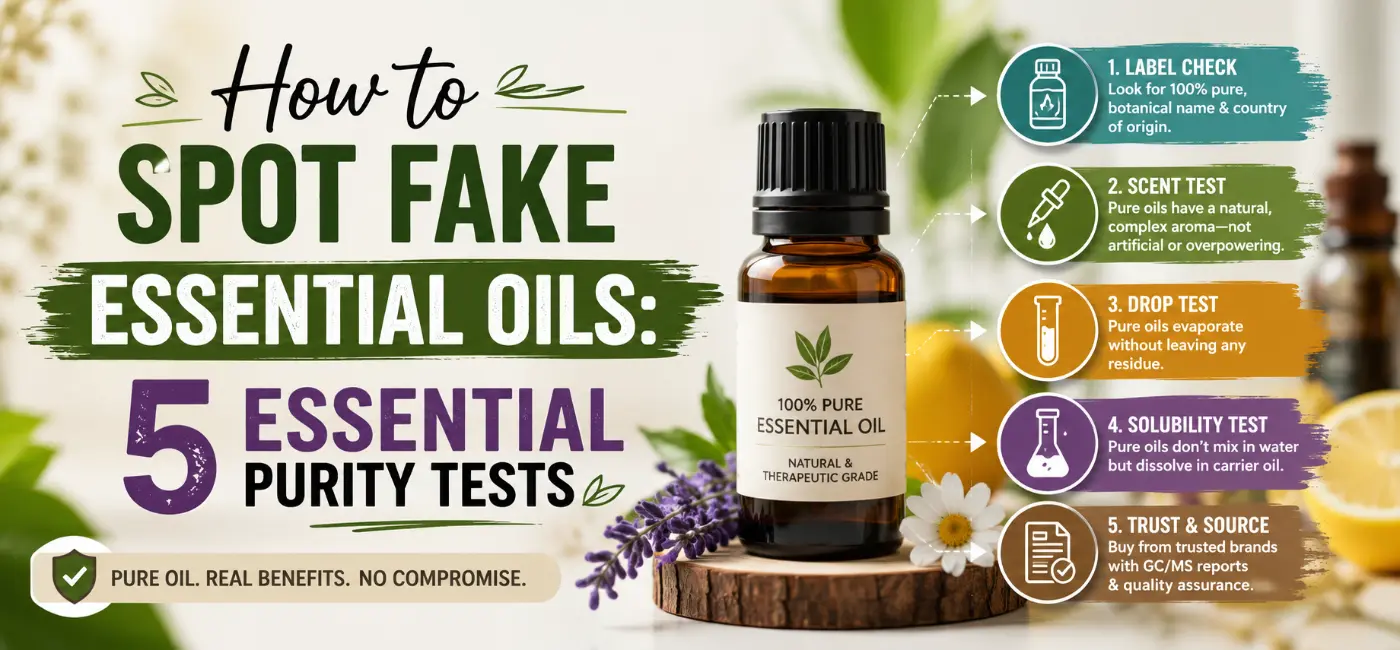
The global surge in clean beauty and holistic wellness has made plant extracts readily available. However, a major marketplace reality remains hidden behind elegant branding: a vast percentage of the products on retail shelves are structurally adulterated.
A market study conducted by testing group NOW evaluated 28 lavender essential oil products purchased from a major online storefront. The results were alarming: only 11% of the tested brands met established ISO standards for purity and authenticity. The rest were systematically stretched, diluted, or outright replaced by synthetic fragrance chemicals.
When you are trying to cultivate a clean lifestyle or design an effective skincare routine, encountering synthetic mimics is highly frustrating. Worse, using adulterated oils can cause contact dermatitis, respiratory irritation, or unpredictable skin sensitization. To protect your home and your health, it is best to start with verified botanicals like our Essential Oil to build a foundation of safety.
To protect your home and your health, you must learn how to look past corporate jargon and use precise, professional techniques to separate real botanical extracts from laboratory shortcuts.
Spotting a fake is step one; knowing what to look for on a genuine label is step two. We break down what actually matters when buying essential oils in our full guide.
The Economic Drivers Behind Essential Oil Adulteration
True purity in a botanical extract is clear to define but challenging to produce. A pure essential oil is a 100% plant extract containing the volatile organic compounds of the host plant nothing added, nothing removed.
The primary driver of the counterfeit oil market is simple economics. Producing pure oils is an asset-heavy, highly resource-intensive process.
| Raw Material | Conversion | Final Product |
|---|---|---|
| 🌸 100 kg Lavender Flowers | =======► | 1 kg Lavender Oil |
| 🌹 2,000 kg Rose Petals | =======► | 1 kg Rose Absolute / Oil |
Because agricultural yields depend entirely on climate patterns, crop safety, and harvest labor, market prices experience massive swings. For example, severe weather anomalies in Madagascar frequently cause the price of true Vanilla planifolia to skyrocket.
To bypass these supply line expenses and maintain high profit margins, low-quality manufacturers turn to essential oil adulteration through three common industrial strategies:
Carrier Oil Dilution: Mixing expensive essential oils with unscented, fixed vegetable lipids like fractionated coconut oil, mineral oil, or sweet almond oil to artificially boost volume.
Synthetic Isolates: Stretching a thin amount of organic extract with lab-created, “nature-identical” aroma molecules to mimic the target plant’s profile at a fraction of the cost. This practice is one of the many clean beauty dirty secrets that brands hide from consumers looking for authentic formulations.
Botanical Stretching: Introducing cheaper, highly abundant botanical relatives into premium batches. A classic example is mixing inexpensive Geranium (Pelargonium graveolens) or Palmarosa oil into high-cost Rose (Rosa damascena) oils to deceive consumer sensory evaluations.
The "Therapeutic Grade" Marketing Trap Deconstructed
Many consumers actively search for “certified therapeutic grade” labels, believing it signifies a rigorous, third-party verified quality ranking.
Industry Fact: There is no universally recognized, independent regulatory body or government agency (such as the USFDA, UK Medicines and Healthcare products Regulatory Agency, or European Medicines Agency) that assigns quality grades to essential oils.
Terms like “therapeutic grade,” “grade A,” or “medicinal purity” are internal, trademarked corporate slogans designed for marketing differentiation. They carry zero legal weight or standardization across different brands. To truly protect your well-being, it is vital to learn the truth about therapeutic grade essential oils before trusting front-label claims.
Instead of trusting catchphrases, evaluate a brand based on its verifiable technical transparency, raw batch tracking data, and structural analytical documentation.
Visual Sentry: Deciphering the Bottle and Label Architecture
Your initial verification line begins before you open the product. Trustworthy producers use highly transparent labeling that outlines the exact technical identity of the batch.

The Critical Need for Botanical Nomenclature
If a bottle is simply labeled “Lavender Oil” or “Eucalyptus Oil,” treat it with skepticism. Pure essential oils always state the two-part Latin name representing the exact genus and species of the plant source.
Real Identification: Lavandula angustifolia (True Lavender) vs. Lavandula latifolia (Spike Lavender).
Why it Matters: These distinct species carry entirely different molecular profiles and therapeutic actions. Using the wrong chemotype or species can lead to poor skincare outcomes or unexpected dermal reactions. If you are experiencing unexplained irritation, it could be one of the skincare mistakes ruining your glow that you need to resolve for clearer skin.
For example, when using robust extracts for topical applications or defensive care, prioritizing a properly labeled Tea Tree Essential Oil ensures you are getting the true Melaleuca alternifolia species.
Packaging Integrity: Containers and Regulatory Disclosures
The physical bottle provides immediate proof of quality. Pure volatile compounds react strongly with plastics, causing chemical leaching that destroys the oil and pulls plastic micro-particles into the solution. Genuine oils are exclusively packaged in dark amber or deep cobalt blue glass bottles. This shading filters out damaging ultraviolet rays, preventing internal photo-oxidation and rancidity.
Furthermore, authentic labels show clear operational details:
Extraction Method: Explicit indicators detailing whether the oil was extracted via steam distillation, cold-pressing, or CO2 extraction.
Origin Mapping: Clear naming of the specific country where the host crops were harvested.
Batch Tracing Numbers: A stamped batch code that links the individual bottle back to its manufacturing distillation window.
Fragrance Allergen Compliance: Updated international labeling guidelines mandate transparency for specific fragrance allergens. Reputable brands explicitly declare these natural molecular constituents on the back label.
Avoid items explicitly carrying the designations “fragrance oil,” “perfume oil,” “nature-identical,” or “ambient home scenting fluid.” These are standard consumer indicators for fully synthetic, petroleum-derived compound packages built strictly for ambient aromas rather than biological application.
Practical At-Home Diagnostic Verification
While laboratory analytics offer absolute validation, you can run simple, highly reliable at-home checks to quickly detect coarse adulteration or heavy carrier stretching.
The Drop & Evaporate Paper Test
Because pure plant essences contain highly volatile molecules, they evaporate cleanly when exposed to moving air without leaving a heavy, lipid residue.
Prepare the Material: Requires white printer paper. Lay a clean, flat piece of white printer or parchment paper across a non-reactive glass or ceramic surface.
Apply the Sample: Single drop dose. Dispense a single drop of the test essential oil directly onto the center of the paper surface. Do not rub or spread the liquid.
Allow for Evaporation: Wait 30 to 60 minutes. Leave the paper completely undisturbed for roughly an hour, allowing the natural volatile organic chemicals to evaporate off the cellulose surface.
Inspect the Residual Signature: Evaluate under bright light. Hold the paper up to a direct light source. A pure, unadulterated oil will leave no greasy residue or slick ring. The paper surface will feel bone dry.
Exceptions to the Rule: Heavy, highly viscous wood or resin extracts such as Patchouli (Pogostemon cablin), Vetiver (Chrysopogon zizanioides), and Myrrh (Commiphora myrrha) possess large, complex structures. They may leave a natural amber or faint brown coloration on the paper, but this mark will never feel slick, greasy, or oily to the touch.
The Failure Signature: A persistent, semi-translucent, slick grease ring indicates the addition of low-cost carrier oil stretching agents like vegetable oil or isopropyl myristate.
Sensory Benchmarks: Texture and Evolution Profile
The Tactile Test: Rub a single drop of the oil between your index finger and thumb. Pure essential oils absorb cleanly into the skin layers within moments, leaving a lightweight, crisp sensation. If the fluid feels syrupy, heavy, or mimics the greasy slippage of standard cooking oils, it has been mixed with a fixed carrier base.
The Evolution Profile: Synthetically constructed fragrances are linear and unchanging; they smell exactly the same from the initial opening spray until hours later. Pure botanical oils present an evolving scent profile. Because the natural solution contains hundreds of unique, trace aromatic elements, the aroma transforms over time as it moves through volatile top notes, deep middle notes, and lingering fixative base notes. If you want to study how these complex natural layers interact with human physiology, exploring the clinical impact of your brain on lavender oil every night reveals the distinct difference between real extracts and flat synthetics.
The Solubility Test: True oils do not dissolve in water. If you add a drop of oil into a glass of plain water and it instantly dissolves or turns the entire water column milky white, the oil has been pre-mixed with synthetic chemical emulsifiers or polysorbate surfactants.
Technical Integrity: The Gold Standard of GC-MS Testing
For absolute verification, expert aromatherapists and commercial buyers rely on Gas Chromatography-Mass Spectrometry (GC-MS) analysis.
A GC-MS evaluation works in two distinct phases:
Gas Chromatography: The oil sample is vaporized and driven down an analytical column, separating the compound into its individual chemical constituents based on molecular weight and volatility.
Mass Spectrometry: Each individual constituent is fragmented by an electron beam, mapping a distinct mass spectrum that acts as a definitive chemical fingerprint.
| Component / Parameter | 🌿 Pure Botanical Extract | 🧪 Synthetic Fragrance Oil |
|---|---|---|
| GC-MS Reporting | ✅ Verifiable compound peak layout mapping naturally occurring percentages. | ❌ Shows artificial solvents, fixed phthalate markers, or singular flat isolate peaks. |
| Chemical Complexity | 🌱 200–500 naturally occurring trace compounds working together in synergy. | ⚗️ 5–15 synthetic chemical isolates designed to mimic a basic scent profile. |
| Long-Term Stability | 🌞 Highly volatile; naturally oxidizes over time when exposed to heat, air, or light. | 🧴 Highly stable; preserved using artificial stabilizers and chemical fixatives. |
Dedicated essential oil brands consistently make these independent batch GC-MS laboratory charts accessible to consumers upon request. This practice provides transparent proof that the oil is completely free of industrial synthetic adulterants.
Frequently Asked Questions
1. How do I identify 100% pure essential oil?
Always check the label. It must explicitly display the plant’s botanical name (e.g., Lavandula angustifolia), state “100% Pure Essential Oil,” and list zero chemical or synthetic additives.
2. Can I test the purity of essential oils at home?
Yes, with the “Paper Test”! Drop a single drop of oil onto white paper. If it evaporates completely without leaving a greasy or oily ring behind, it is highly likely pure. Fake oils almost always leave a lasting stain.
3. Why should I avoid buying cheap essential oils?
Extracting true essential oils requires massive amounts of natural leaves or flowers, making them premium by nature. If an oil is unusually cheap, it is undoubtedly diluted with cheap carrier oils or synthetic chemicals.
4. What does the bottle color indicate about purity?
Pure essential oils are always packaged in amber (dark brown) or blue glass bottles. Plastic or clear glass bottles allow sunlight to degrade the oil, which is a red flag for a fake or low-quality product.
5. Can you spot a fake essential oil by its scent?
Yes. If the oil emits a harsh, artificial perfume aroma or a chemical, laboratory-like smell, it is synthetic. Genuine essential oils have a subtle, complex, and completely natural scent true to the original plant.
6. Where can I buy the most pure and reliable essential oils?
Always purchase from brands that publicly share their GC/MS lab test reports. Every oil available on our website is 100% lab-tested, pure, and organic — Click here to explore our collection.
Key Takeaways
Look for Latin Specifications: Always confirm that the bottle displays the true genus and species formatting (e.g., Melaleuca alternifolia).
Skip the Buzzwords: Recognize that labels like “100% Therapeutic Grade” are marketing terms, not certified regulatory grades.
Insist on Amber Glass: Avoid any brands using clear glass or plastic packaging for volatile oils.
Use the Paper Test: Perform an at-home paper evaporation check to quickly catch hidden carrier oil dilution.
Verify the Analytics: Choose brands that back up their inventory by providing batch-specific GC-MS diagnostic testing, guiding you straight to the best essential oils in usa pure natural picks for your wellness collection.
Conclusion
Navigating the essential oil market requires looking past striking labels and focusing on botanical data. By checking for explicit botanical names, insisting on protective amber glass packaging, and using simple at-home testing methods, you can easily filter out synthetic imitations. Prioritize buying from transparent producers who share their batch-specific GC-MS reports. Investing a little extra time in verifying purity ensures your aromatherapy practices remain both safe and truly effective. If you are ready to introduce guaranteed botanical authenticity into your home, shop our lavender essential oil today to experience the unadulterated difference.

Ahetesam Sabugar
Ahetesam Sabugar is the founder of Vigrovia. He researches and writes guides on skincare, supplements, fitness recovery and home-gym gear. He isn't a doctor, so every article is built from published studies, ingredient labels and trusted sources like the NIH and Cleveland Clinic, and is updated when new research comes out.
More articles by Ahetesam →